Interlude: an interview with composer and pianist Hanakiv

Sometimes you have to leave home to find a home within yourself. Estonia born pianist, sound artist, and composer Hanakiv embodies this truth. Trained in classical music, and steeped in Estonia’s music and landscape, it was Hanakiv’s move to London that allowed her to draw together all of these things and gave her the courage to chart her own musical path.
Prepared piano. Layered sounds. Hope. Waiting. In Hanakiv’s words, “Interlude just presents these moments, or little glimpses, without necessarily having to arrive at any resolution or answer. It just lets things be.” Each track is an invitation to rest in stillness, to accept ambiguity, and to find hope in the beauty and messiness of life. It’s an honor to feature Hanakiv on No Dead Guys.
I understand that you came from a musician’s family, that you began playing handbells and piano around the age of 8, and yet you swore you’d never become a professional musician. What changed your mind?
My mother and my grandmother are musicians and I lived with both of them until the age of 5, and with my mother till the age of around 13 so my initial connection to music came from there. I can’t remember what exactly brought this change of mind, but I was curious and excited to play music, and I think I just really enjoyed making music, and hearing music. It was something natural for me from early age. For example my brother and sister never chose that path, but for me it just brought a lot of joy although I didn’t want to admit it, and in the beginning I framed studying music as something I was willing to do to make my mother happy.
When did you begin writing compositions and what was your first piece?
My first memory of writing a finished piece is from when I was maybe 10 or 11. I did write something before that but I don’t have any memories of actually finishing a piece of music before that. The piece was about my sister’s dog called Pirtsu and it was called something like ‘A walk with Pirtsu’, and I definitely ripped off from some Czerny exercises and etudes there, but I remember the excitement of realising that I could create music on piano.
You’ve stated that while you continue to be influenced by the music and natural surroundings of your native Estonia, that it was your move to London that gave you the freedom to create your own music. Why do you think this is so?
I would like to clarify that a bit. I have created my own music since I can remember, but before Hanakiv I created commission-based music. Moving away from Estonia helped me to approach music more intimately, and made me courageous enough to write for myself, and start performing my own music. When you move to another country, especially to a big city, you become anonymous and you can recreate yourself. I was able to get rid of the expectations that I had put on myself. I’ve had to get rid of a lot of shame regarding not feeling good enough to be a musician. I believe partly that I felt like this because I didn’t follow the regular music school path that you’d normally follow in Estonia before going into higher education, and moving away just made me realise that I can do absolutely whatever I wanted, and that I am the only one to give permission to myself. I am currently at the point, where I want to bring this side back to my practice and connect what I do as Hanakiv to what I did before. So every step on the way has been important, but creating this space for Hanakiv has tremendously helped me to connect with creating from my heart.
You’re known for your love of prepared piano and you’ve found that it’s easier for you to connect to it than normal piano. Why?
Maybe because I associate it [normal piano] too much with expectations, or maybe out of respect to pianism - I value the art, and people who have dedicated their lives to it. I associate piano sound (especially grand piano sound) with classical music in general. It’s loud, big, and immediately draws images of concert halls and practice rooms to my mind. I’m probably just much more interested in creating my own sound worlds, and it just hasn’t fit into the worlds I’ve tried to create.
Congratulations on your recent performance at SXSW London with Classical Unlocked! What can you tell me about this festival and how did your music fit into the overall theme of the event?
I think a lot of musicians share this experience of trying to run away from classical music, only to return to it from a completely different perspective. That period of searching becomes part of the creative process, and what first feels like a struggle eventually enriches the music. I felt a strong need to distance myself from classical music for a while, and my last album Interlude is probably the furthest I've moved away from it. But along the way I’ve also realised more strongly that the foundation of everything I make is still, at least partly rooted in classical music.
Now I find myself wanting to return to it more consciously, still blending it with other genres that excite me. Having explored different musical worlds along the way makes that return feel fresh and exciting. Classical music has an incredible capacity to evolve, absorb new influences and take on new forms, and I think that's exactly what makes it so relevant today. If my music helps someone connect with classical music from a different angle, then that's something I'm really grateful for.
More broadly, SXSW London was inspiring because it brought together people who are all thinking about where music is heading. One area I've been interested in since my studies is immersive sound, so it was fascinating to hear conversations about its future. What I found most reassuring was that despite all the technological innovation, the focus remains on human connection and shared experience. Ultimately, that's what I'm trying to create with my own music as well.
Congratulations also on the release of Interlude, your second album. This recording has been lauded as a “richly personal, genre-blurred space where piano—often prepared—sits alongside analogue and electronic textures.” Tell me a bit about your decision to expand your sound world with other instruments.
I can’t say it was a decision, it just came out this way. When I was making Interlude I didn’t feel at all that I was expanding my sound. Goodbyes [my first album] already had all these elements, just on a smaller scale - “Home II” had string arrangement, “Meditation II” had vocals, “Goodbye” had drums, there were synths, lots of granular synthesis in production, sax on two tracks, piano preparations. Also, because I was making Interlude mostly at home, it rather felt like scaling back. But I’ve heard from so many people that Interlude feels bigger and more produced than Goodbyes, and by now I completely agree with that. I’ve just taken all these elements, and used them throughout the album more intensely. I was also much freer with production, especially the rhythmic elements. In general Interlude is more layered than Goodbyes. “Lastele” for example had more than one hundred tracks when it was in the works, in that sense Goodbyes was much more minimalistic.
I read that this album is “a product of creative and personal revelation, reached only through an encounter with one’s true self.” Would you be willing to elaborate on this? And what can you tell me about the challenge of finding movement in stillness as well as the searching quality of so many open-ended ideas?
I loved approaching music through this lens of stillness - no pressure to develop or move from one point to another, to tell a story, to arrive anywhere. A lot of this music did end up being stories, and have development in them, but overall the starting point was always very limited, and the musical material has much more repetition in it than for example Goodbyes. It was almost a fight with myself - something in me was very much against constantly developing, and pushed me to explore this muscle of keeping things simple, and just letting things be. There is still movement on this album because although written from a place of standing still, there is hope for it there. When there’s hope, there’s always some kind of movement. The more I write music as Hanakiv the more I see how hope is a recurrent theme. Interlude just presents these moments, or little glimpses, without necessarily having to arrive at any resolution or answer. It just lets things be. It was probably the first time in my life since childhood when I allowed myself to write like this. All together it is a little interlude of life.
Throughout this album I had the sense of waiting, of time being suspended. What can you tell me about the “in-between” nature of these pieces?
All of this pieces or songs are almost like little rooms of bigger atmospheres you enter. You stay in them without realising how much time has passed or whether time is passing at all. So they’re these little frozen moments from bigger spaces. Maybe this is relevant with all creations, but this idea became especially important to me when writing this album, and it allowed the stillness in. I visited my own memories, sometimes the memory was just a memory of a feeling, sometimes a few second scene. So in a way I was suspending my own memories.
While I enjoyed every track on Interlude, I was particularly drawn to “Numb,” a piece that sonically captures the experience of standing still while life continues outside of one’s head. What was the inspiration for this piece?
Until writing “Numb” I was under the impression that I was writing about stillness. Realising that I was partly numb, or unable to feel fully was a huge relief. There is a lot of this internal screaming, but also power. When you understand something, you can choose to act - you can choose to move towards movement, or continue standing still. “Numb” is the realisation of being a bit trapped in your own head.
The added vocals on many of these tracks are beautiful and lilting. How long have you been a singer, in addition to being a pianist and a composer?
I have sung in choirs when I was younger, and I also took some singing lessons for fun during my studies. I wouldn’t call myself a singer, but I just love using my voice. There is something very powerful when there is room or space where you can just make a loud voice without having to worry. Last year me and my friend started a tradition where we’d go to a deserted bog in Estonia, and scream at the top of our lungs for about 30 seconds. I highly recommend it to everyone.
Do you offer sheet music for your compositions—either for Interlude or your debut album, Goodbyes? If so, where might we purchase it?
I haven’t released any sheet music yet, but it’s been on my mind for a long time. I’m dreaming about releasing a sheet music book for Interlude, and some sheet music for Goodbyes. Hopefully not too long in the future!
What advice can you offer other musicians seeking to create careers for themselves as performers or composers?
I’m still figuring it out myself how to make music into a sustainable career so I am not the right person to give advice here. But I’d say surround yourself with people who believe in what you do.
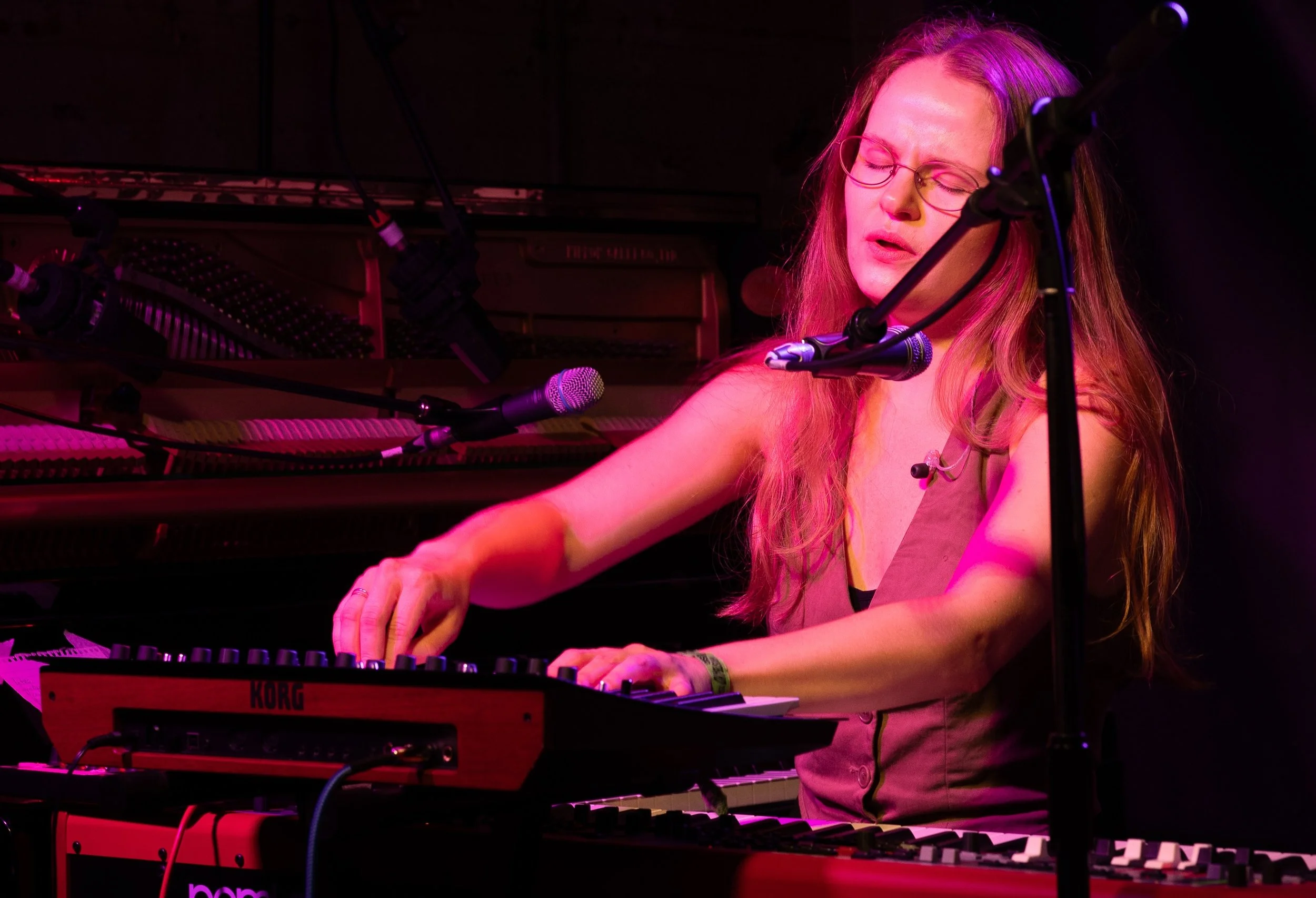
Hanakiv is a London-based, Estonian-born pianist and composer who creates meditative, piano-based ambient music, with classical and electronic elements.
She made her debut on Gondwana Records in 2023 with the album Goodbyes, which draws on influences as diverse as Tim Hecker, Björk’s Vespertine, Kara-Lis Coverdale, Arvo Pärt, Erkki-Sven Tüür, and Aphex Twin, as well as her own cultural heritage. Music plays an important role in Estonian culture, particularly choral music and its traditions, but Hanakiv also draws inspiration from her love of nature—the beautiful Estonian seaside and forests, and from her time in Iceland.
On her second album, Interlude, Hanakiv showcases an expanded sound, introducing vocals, string arrangements, and beats alongside prepared piano. The compositions trace a journey of overcoming the past, unfolding into a seductively unconventional style imbued with hope and a therapeutic quality.
First inspired by “crystallised moments where time almost stands still, pain hasn’t yet fully set in, and happiness is still just a glimpse,” it provides, all the same, “a sense of hope that standing still is part of living.” This album is a product of creative and personal revelation, reached only through an encounter with one’s true self.
Hanakiv performed at SXSW London as part of Classical Unlocked’s showcase. Interlude, her second album is out now on @gondwanarecords https://gondwana.lnk.to/interlude