Sunday: an interview with composer Suzanna Lam
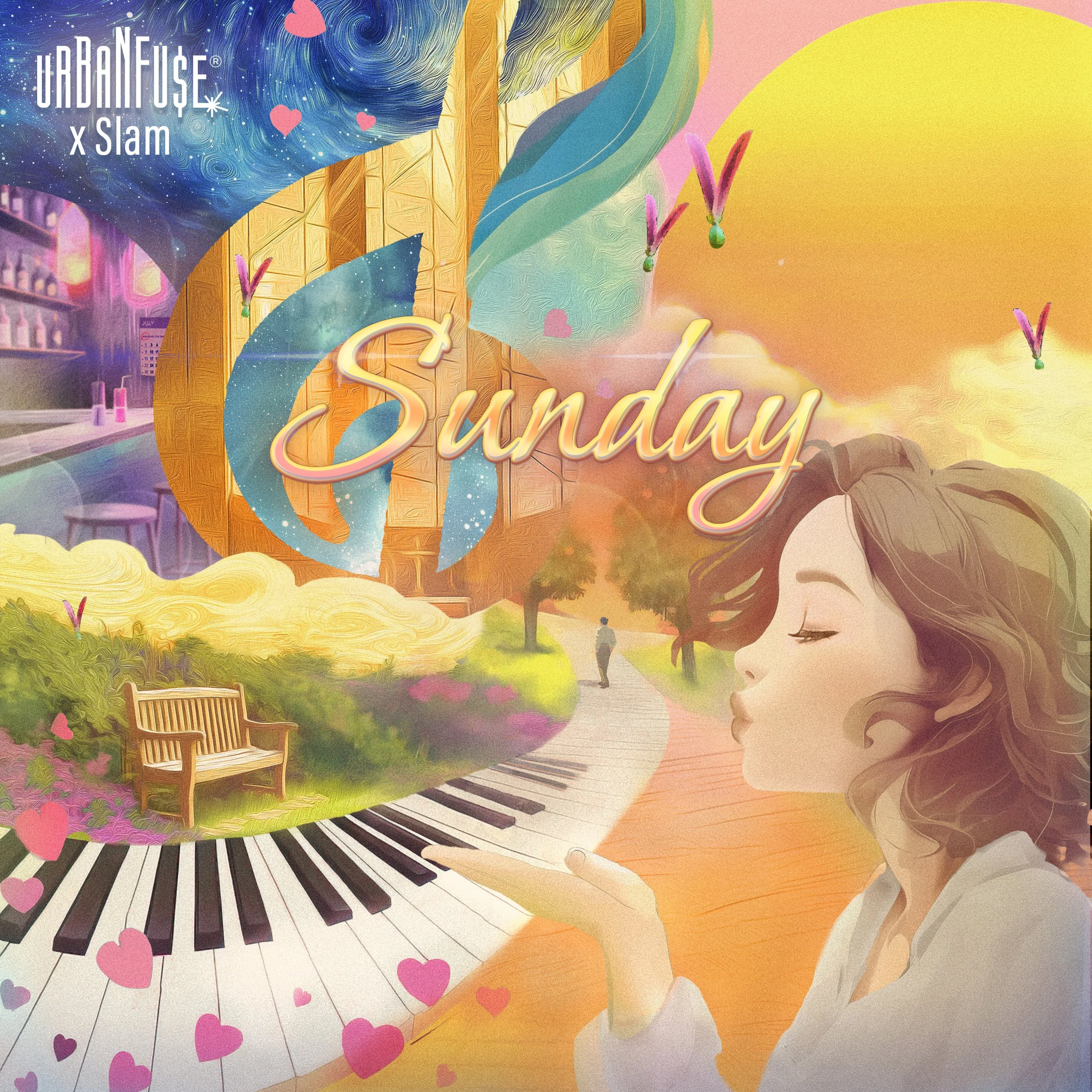
Reflection. Memory tape. Sorrow. Rain. Jazz. Noel. The settings change, the thread that connects them stays the same. Welcome to the many-faceted world of Suzanna Lam (aka Slam). Using the timelessness of Handel’s Passacaglia as the foundation of this album, Slam takes the listener through 20 different stories—almost 20 different lives. Each one layers textures and sounds, evoking a cinematic glimpse of captured moments and emotions. Together, the tapestry of these pieces showcase the marriage between what’s transitory, what’s permanent, what’s individual, and what’s universal.
Slam doesn’t perform live, preferring to present herself as a visionary, storyteller, and creator of experience and change. Yet her beautiful piano playing forms the backbone of this album, and her elegant, tasteful musicianship shapes every note of these pieces. In her own words, she seeks to “blend the heart of music with the mind of transformation.” With Sunday she succeeds. It is an honor to feature Suzanna Lam and this beautiful album on No Dead Guys.
At what age did you begin making music and what was your first instrument?
I began making music in 2018, when I was forty-seven years old, and the piano was my first instrument. Unlike many composers, I didn't grow up dreaming of writing music. In fact, I didn't set out to become a composer at all. Music entered my life through an entirely unexpected door. I still remember sitting at the piano and asking myself, "Have I started too late?" Looking around, it seemed as though every great composer had begun as a child or much earlier in life typically in their late teens or twenties. I couldn't help wondering whether I had missed my opportunity by forty plus years. Over time, though, that question gave way to another realization. I hadn't started late at all. The first forty-seven years of my life hadn't delayed the music; they had prepared me for it. Everything I had experienced before then, my work, my faith, the people I had met, the questions I had wrestled with, even the mistakes I had made, became part of the music I would eventually write. I realized that composing wasn't beginning a second life; it was giving voice to the first one. Today, I no longer think about whether I started late. I simply believe that every life prepares us differently for the work we're meant to do.
I understand that you didn't pursue a career in music until 2018. What sort of work did you do before then, and how does it influence your compositions?
Before becoming a composer, and still today, I work as a CPA specializing in tax planning, business consulting, and designing financial systems for families and entrepreneurs. Most people assume accounting and music belong to completely different worlds. I've never experienced them that way. Both disciplines ask the same fundamental question: How do individual pieces come together to create something meaningful? In tax planning, those pieces are laws, numbers, and long-term decisions. In music, they're melody, harmony, rhythm, memory, and emotion. Both require patience, structure, and the ability to see relationships that aren't immediately obvious. Over the years, however, I noticed something that troubled me. My clients often understood the ideas we discussed during our meetings. They left feeling inspired and motivated. But months or years later, despite regular follow-up meetings, many of those ideas had faded. Information alone wasn't enough to produce lasting change. Around the same time, I was mentoring entrepreneurs and asking them how they spent their days. A pattern quickly emerged. Many were spending hours each week commuting while listening to podcasts, audiobooks, and music. That observation led me to a question that changed the course of my life: What if the ideas I wanted people to remember weren't delivered through presentations or consultations, but through songs they could return to again and again? I already had a piano sitting in my home, but until then it had simply been another piece of furniture. Suddenly, it had a purpose. I began teaching myself how to compose, not because I dreamed of becoming a musician, but because I believed music could carry ideas farther than a conversation ever could. My earliest songs including Retire in Peace (R.I.P.), All I Got Is You, Big, No Luck, Secret Pyramid, Pan Am Highway, Powerful Woman, Scarred Dreamer, and Joker weren't written simply to entertain. They were deeply personal, but they were also invitations for listeners to think differently about success, purpose, leadership, relationships, and the way they spend their lives. Looking back, I don't think I became a composer because I wanted to write music. I became a composer because I was searching for a better way to help people and myself remember ideas that could genuinely change the way we live.
Everything I've composed since then, including Sunday, has grown from that same question.
Whether I'm helping a family prepare for retirement or composing an album, my purpose hasn't really changed. I've spent my life trying to help people build better futures. Music simply became another way of doing that.
You’re a rare musician who chooses not to perform live concerts. Why?
I've never viewed myself primarily as a performing artist. From the very beginning, I saw myself as a designer of listening experience who happens to play the piano, rather than a concert pianist or touring musician. My earlier work explored hip-hop, rap, pop, and EDM, and even then, my focus was on creating recordings that people could return to again and again, wherever they happened to be.
I've never believed that every composition reaches its fullest expression on a stage. Some works are written for live performance. Others are conceived for a different kind of listening experience. Sunday made me realize that distinction more clearly than ever.
The album depends on intimate listening and on changing acoustic environments that are woven into the composition itself. Those sonic spaces aren't simply backgrounds; they're part of the musical structure. Remove them, and you change the work. Ironically, I think the most intimate performance of Sunday doesn't happen in a concert hall. It happens when one person sits alone, puts on a pair of headphones, and gives the music their complete attention.
People sometimes ask when I'm going to tour. I usually smile and say that Sunday is already performing every time someone puts on a pair of headphones. The recording isn't documentation of the work. The recording is the work.
What can you tell me about your work as Slam, your group Urban Fu$e, and your stated purpose of creating music that “blends the heart of music with the mind of transformation?”
Urban Fu$e began with a simple conviction: music can move us emotionally while also changing the way we think. When I say I want to blend "the heart of music with the mind of transformation," I'm describing those two dimensions.
The heart is melody, beauty, emotion, vulnerability, the part of music that speaks directly to our humanity. Without that emotional connection, people rarely return to a piece.
The mind is what remains after the music ends. It's the questions a composition leaves behind, the memories it creates, and the subtle ways it changes how we understand ourselves and the world around us.
I've never believed those two things are in conflict. When Urban Fu$e collective was formed, I wasn't interested in deciding whether music should entertain or educate. I believed it could do both. My hope is that people first enjoy the music simply because it is beautiful or emotionally meaningful. But if they come back to it weeks, months, or even years later and discover that it has quietly changed the way they listen, the way they think, or even the way they live, then I feel the composition has fulfilled its purpose.
In that sense, every project I've created, from my early hip-hop and pop songs to classical crossover, Sunday, has been exploring the same idea.
Not simply how music sounds but what music can do.
Congratulations on the recent release of your latest album, Sunday, a 20-movement piece created around Handel's Passacaglia. Given that you've cited Michael Jackson, Madonna, The Beatles, Elvis Presley, and The Temptations as musical influences, what drew you to Handel?
First, thank you. I'm honored that you've spent time with Sunday. It was one of the most joyful and intellectually challenging projects I've ever undertaken.
It's true that many of my musical influences come from contemporary artists such as Michael Jackson, Madonna, The Beatles, Elvis Presley, and The Temptations. But one of the things I've come to appreciate is that much of the music we call "popular" today rests on musical ideas that have been evolving for centuries. For example, the movement of harmony around the Circle of Fifths, repeating bass patterns, memorable cadences, these weren't invented by pop or hip hop/rap musicians. They were refined by composers like Bach, Handel, and countless others whose influence continues to shape the music we hear every day. For me, classical music and popular music aren't opposing traditions.
They're part of the same conversation. People sometimes say that I'm borrowing from Handel. I actually think Handel has been quietly present in popular music all along. The real question wasn't, "Why Handel?" But it was, "What question could Handel help me explore?"
By that point I had become fascinated by a simple but surprisingly difficult question: How long can I listen to the same piece of music before I no longer feel I'm listening to the same piece? I couldn't answer it. So I composed Sunday.
Handel's Passacaglia provided the perfect foundation because its repeating harmonic structure offered something remarkably stable. Rather than continually changing the underlying music, I allowed the musical environments, orchestration, genres, and listening experience to evolve around it. What interested me wasn't how much I could change Handel but it was how much the listener might change while Handel remained largely the same.
This wasn't the first time I had built an album around a classical composer. In 2020, I released Merry Nutcracker Christmas, a seven-track Christmas project inspired by themes from Tchaikovsky's The Nutcracker. Even then, I was exploring what happens when familiar classical music is placed within contemporary musical environments.
One of my hopes is that listeners who might never attend a symphony concert can nevertheless experience the extraordinary beauty of Baroque and classical music in a musical language that already feels familiar to them. In other words, I'm not trying to modernize Handel. I'm trying to create a place where an eighteenth-century masterpiece and a twenty-first-century listener can genuinely meet. Perhaps that's why Handel felt like such a natural companion. As a composer, he gave me musical foundation. The question came from somewhere else.
One of the many things I enjoy about Sunday is the way Handel's Passacaglia becomes the axis around which each movement shifts and changes. What do you feel this interaction of permanence and evolution offers the listener?
Life is full of change. Our relationships change. Our memories change. Our bodies change. Even the way we understand ourselves changes over time. Yet beneath all of that, we spend our lives searching for something that remains. For me, Handel's Passacaglia became a metaphor for that search.
Throughout Sunday, the musical environments, instrumentation, genres, and emotional landscapes continue to evolve, but the harmonic foundation remains remarkably constant. I became fascinated by what happens when something stable accompanies us through continual change. But what surprised me most wasn't what happened to the music, it was what happened to the listener.
As people spent more time with the album (in all editions forward, reverse, track by track, continuous), many told me they gradually stopped noticing Handel's melody in the way they had at the beginning. Others said that passages which had initially seemed almost invisible became deeply moving later in the listening experience.
The underlying music hadn't fundamentally changed but their relationship to it had and that realization became one of the central ideas behind Sunday.
After the release of the album, I invited people to listen and share their experiences. Again and again, I heard the same observation: twenty or thirty minutes into the work, they felt as though they were hearing the same music differently. That was the moment I realized the composition wasn't simply exploring variation. It was exploring perception.
In the end, I don't think Sunday is about how Handel changes. It's about how we change while something enduring remains beside us.
You've been quoted as saying that your songwriting arises from "a shocking event and a good catch phrase." Can the same thing be said about Sunday? If so, what would you be willing to share about your inspiration for this album?
Absolutely. Many of my compositions begin when a single sentence refuses to leave me alone. I don't immediately think of it as a song. Instead, I live with the idea, turning it over in my mind until it begins asking more questions than it answers.
For Sunday, my original sentence was: "We may not be running out of time. We may be running out of uninterrupted moments long enough to become aware of our lives."
That wasn't simply a lyric waiting for music. It became the philosophical foundation of the entire album. We often say that modern life is moving too fast. But I became interested in a different possibility. Perhaps the deeper problem isn't speed itself. Perhaps it's that our attention has become so fragmented that we rarely remain with anything long enough for it to transform us.
That question changed the way I thought about composing. Rather than writing twenty unrelated pieces, I wanted to create a single musical experience that gently invited listeners to remain with the same musical idea long enough for their relationship to it to evolve. In many ways, Sunday isn't asking listeners to slow down. It's asking whether sustained attention has become one of the rarest experiences in modern life. I often describe Sunday this way: It's an eighty-minute experiment in human perception disguised as an album.
Each of the beautiful movements of Sunday invite the listener into a different emotional state. How did you first map out your ideas for this listening journey and what do you hope the listener will understand by the end of the album?
When I first conceived Sunday, I wasn't trying to write twenty different pieces of music. I was trying to answer a question. How long can something repeat before we no longer feel we're hearing the same thing?
Most composers use repetition to create familiarity. I became interested in a different possibility. Could repetition itself become a source of transformation? That question shaped every decision I made. The same four bars of Handel's Passacaglia remain present throughout the entire eighty-minute work, but each movement places them within a different emotional, acoustic, and musical environment. Rain. Reverence. Romance. Stillness. Grace. Sorrow. Joy. Glitch. Each movement becomes another room in the same house, inviting listeners to encounter the same musical foundation from a different perspective. Eventually I realized I wasn't really composing twenty separate pieces but designing a musical system that was remarkably simple: Keep Handel constant. Change everything else. Then observe what happens, not only to the music, but to the listener. What fascinated me was that, over time, people often stopped hearing the Passacaglia as something external. Instead, it began interacting with their own memories, expectations, emotions, and experiences. The harmonic foundation remained remarkably stable, yet each return felt different because the listener had changed. That became the real composition. By the end of the album, I don't hope listeners arrive at a particular conclusion. I hope they begin to suspect that the real composition was never confined to the notes. It emerged slowly through their changing relationship with them. If Sunday succeeds, the music becomes less the object being observed and more the quiet catalyst through which listeners observe themselves.
We often think of repetition as the absence of change. Sunday proposes the opposite. When something remains with us long enough, repetition doesn't prevent transformation. Instead, it reveals it. Perhaps the music was never changing as much as we thought. Perhaps we were.
One of my favorite things about Sunday is your masterful rendering of memory—all the ways it haunts or comforts us, and all the ways it's imperfect. What can you tell me about the role of memory on this album?
Memory fascinated me because it isn't something we simply store. It's something we continually recreate. Every time we revisit a memory, we don't recover it exactly as it was. We bring our present selves into that encounter, and in doing so, we subtly reshape the past. As I worked on Sunday, I began to realize that listening works in much the same way.
When listeners first encounter Handel's Passacaglia, they're hearing it as something new. It naturally draws their attention. But after twenty movements, the music has become familiar. It has become part of their memory. What's remarkable is that Handel's notes haven't changed.The listener has.
The same musical idea now carries everything that has happened during the previous hour of listening. Every return to the Passacaglia is colored by the emotional journey that came before it. That fascinated me because it suggested that memory isn't simply something music evokes. Memory is something music creates. Perhaps that's one of music's quiet miracles. It reminds us that the past never returns unchanged. Neither do we.
You've stated that your musical mission in all your work is "to help people wake up to their lives, not in the future, but in the now. To use music as a lens, a language, and a lantern for truth." In what ways does Sunday reflect this goal?
Many people think music exists to help us escape life. I've always believed music can also help us return to it.
Sunday wasn't composed to transport listeners somewhere else. It was composed to bring them more deeply into where they already are. Throughout the album you'll hear things we often overlook: rain against a window, footsteps, someone quietly counting, the sound of breathing, moments of silence. Those sounds aren't decorative, and they aren't interruptions to the music, either. They are part of the composition because they're part of life. We spend so much of our lives waiting for extraordinary moments that we sometimes overlook the ordinary ones that quietly shape us every day.
One of the beautiful things about music is that it can change the way we experience the world long after the final note has faded. Think about hearing a favorite song from childhood. The recording hasn't changed, yet somehow it means something completely different today because you have changed.
I wanted Sunday to work in a similar way, not simply while someone is listening, but afterward. Some listeners told me that after spending time with the album, they began hearing the sounds inside their own homes differently. They noticed rain they would have ignored before. They paid attention to silence. They became aware of the rhythm of ordinary life in ways they hadn't experienced previously. To me, that may be the greatest compliment I've ever received because if Sunday succeeds, I don't hope listeners simply remember the album. I hope they begin listening more carefully to their own lives.
I understand that for you, Sunday is "in search of divine order within human impermanence." What did you hear in Handel's Passacaglia that made it the right ground bass around which to express this idea?
From the moment I began listening to Handel's Passacaglia, I was struck by the quiet confidence of its ground bass. Everything above it changes. Melodies evolve. Harmonies expand. Textures come and go. Yet the foundation remains remarkably constant.
That musical relationship immediately resonated with me, not only as a composer, but as a Christian. My faith teaches me that while human experience is constantly changing, God's nature does not. Our circumstances, emotions, relationships, and understanding may shift throughout our lives, but there is a deeper reality that remains faithful and unchanging.
As I spent more time with Handel's Passacaglia, I began to hear its ground bass as a beautiful musical metaphor for that idea. I wasn't trying to compose religious music or illustrate a theological argument. I simply just wondered whether an unchanging musical foundation could quietly point toward an unchanging divine reality without ever needing to explain itself.
Sometimes I'd laugh because after hearing the same four bars hundreds of times, I was still discovering something new. That experience reminded me of faith itself. The truth hadn't changed. I had. Looking back, I don't think faith was something I inserted into Sunday. It was already present in the question the album was asking.
What current and future plans are you most excited about?
Sunday was never intended to stand alone. From the beginning, I saw it as the first chapter of a much larger artistic journey exploring constancy, transformation, and the ways we experience time. One thing I've learned is that every project begins with a question I can't answer. For example, Sunday asked what happens when something remains constant long enough for our relationship with it to change.
My next project begins with a bell. Most people think of bells as the sound that marks an event. I'm becoming increasingly interested in what happens after the strike—in the resonance that lingers after the sound itself has faded. I'm exploring whether that resonance, rather than the bell, can become the true subject of a composition. In many ways, it's another way of asking how time continues to shape our experience long after the original event has passed.
The project after that begins with a lake. Once again, a single recurring musical idea will remain present while the surrounding emotional and environmental landscapes continually evolve. If Sunday explores permanence within change, the lake project asks how place, memory, and stillness shape the way we experience time. Although each project has its own musical language, I don't think of them as sequels. I think of them as different conversations with the same mystery. Each one begins with something remarkably constant such as a memory, a bell, a lake, and asks what that constancy reveals about being human. Looking back, I realize I'm not really trying to write albums. I'm trying to ask better questions. I hope that, taken together, these works become a body of music that invites listeners not only to hear familiar sounds differently, but perhaps to experience their own lives differently as well.
You've stated that "Real success is becoming the creator of your own future, physically, emotionally, mentally, spiritually, and financially." What advice can you offer other musicians who seek to do this?
This is unpopular advice, but here it is: Don't build your career around chasing trends.
Build it around questions you can't stop asking. Skills can be learned. Technology will change. Markets will change. But genuine curiosity has extraordinary staying power. The questions that continue to pull you forward will shape your work far more deeply than whatever happens to be fashionable now. I also don't believe our artistic lives exist separately from the rest of who we are.
Our health, our relationships, our finances, our faith, and our creativity constantly shape one another. The greatest artists don't simply produce remarkable work. They become the kind of people capable of creating it. When I released my first hip hop commercial track “Can’t Steal My Deal” at forty-seven, I never imagined someone would one day interview me about Handel. That experience taught me something I wish more people would believe, which is this: Don't measure your life by how early you begin. Measure it by whether you've found a question worthy of your life.
Looking back, I've spent my career helping people build better futures—first through tax and retirement planning, then through leadership and business planning, and now through music. For a long time, those seemed like completely different careers. Today they feel like different expressions of the same calling. They all begin by asking better questions. They all exist to help people see possibilities they couldn't see before. That's what I hope my music does as well. And if success has any lasting meaning, perhaps it isn't becoming someone the world remembers. Perhaps it's becoming someone who creates work that could only have come from the life you've lived.

Slam (Suzanna Lam) is a Visionary, Storyteller and Creator of experience and change. The creative force behind Urban Fu$e, Slam blends the heart of music with the mind of transformation. Shaped by icons like Michael Jackson, Madonna, The Beatles, Elvis Presley, and The Temptations, her work spans genres and cultures - but always returns to one purpose: to create music that sparks personal evolution through five key dimensions of life: Spiritual, Physical, Emotional, Mental, and Financial (SPEMF).
Though Slam is the only professional musician in her immediate family, music runs through her bloodline. Her maternal grandparents played in a local band in the 1940s, performing with instruments like the mandolin and accordion before giving it all up to raise ten children during wartime. Their musical past was largely lost to history, no recordings, no souvenirs, but it lives on in spirit through Slam’s compositions and drive.
Her mother also played piano and traditional Vietnamese instruments like the đàn tranh and đàn bầu in her youth, while several uncles were part of the Chi Tai Brothers Band, which performed across the Vietnamese diaspora in the U.S. One uncle went on to achieve national fame as a comedian and actor before passing away in 2020, a loss that inspired Slam to create a tribute page in his memory.
Her journey into professional music began in late 2018, just before the release of Can’t Steal My Deal. What started as a personal experiment turned into a calling. “Something happened,” she says, a turning point she discusses more deeply in her long form writing, and from that moment on, she committed to putting herself and her voice into the world.
Unlike many artists, Slam doesn’t perform live. She prefers to be the force behind the curtain, shaping sound, building stories, and igniting change. Her songs often begin with a shock, an event, a phrase, a truth that won’t sit still. That’s what unlocks the flow. To Slam, success isn’t fame or streams, it’s living intentionally, on her own terms, with awareness and integrity. "So many people are imprisoned by beliefs they never chose,” she says. “Real success is becoming the creator of your own future, physically, emotionally, mentally, spiritually, and financially." Lam’s mission is clear: To help people wake up to their lives, not in the future, but in the now. To use music as a lens, a language, and a lantern for truth. And to leave behind a catalog of songs that compound joy, growth, and consciousness, just like interest in a well-loved account.