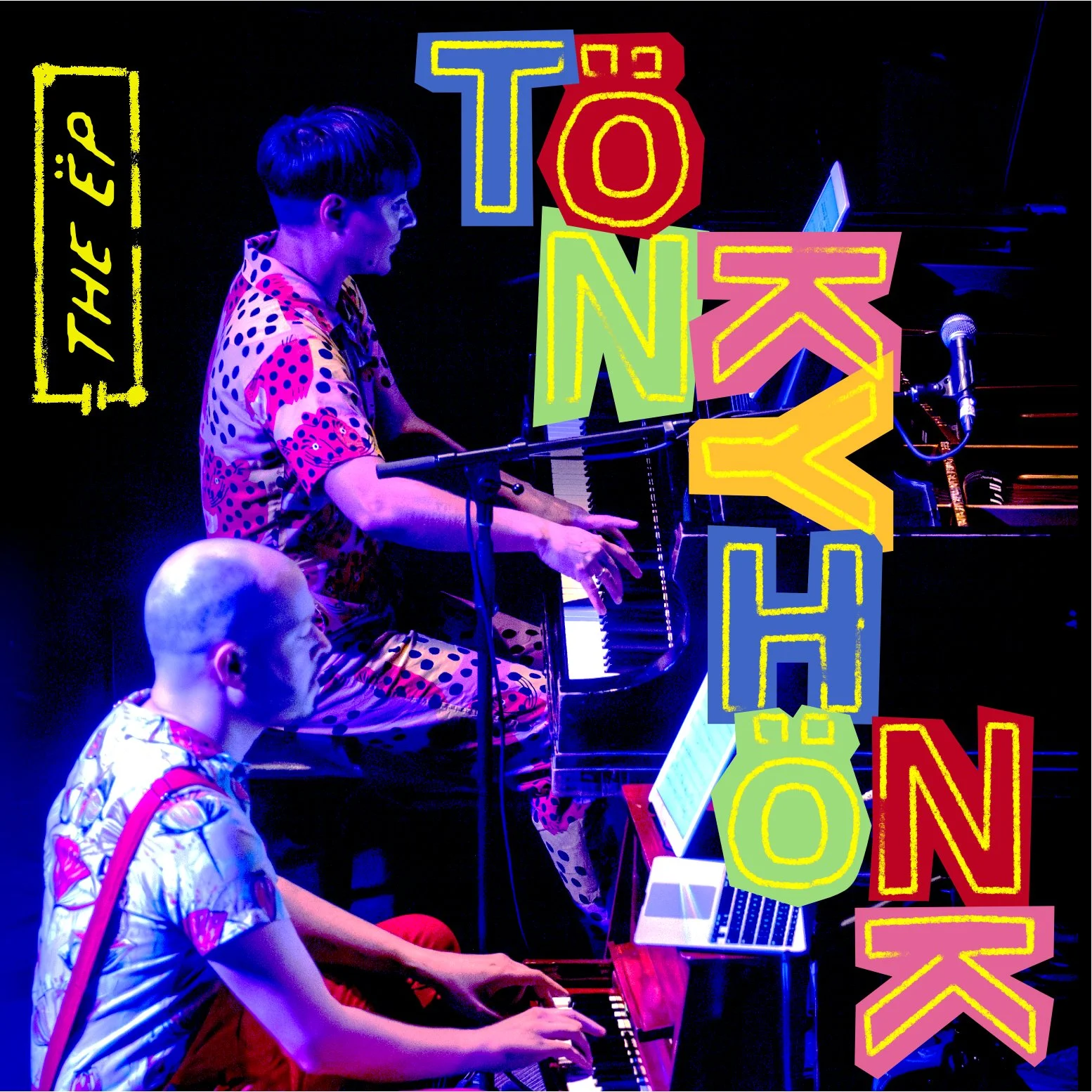
Bright colors. Multiple Umlauts. World class playing. Meet Tönky Hönk, a duo created by concert pianists and childhood friends Madeline Hildebrand and Everett Hopfner. Declaring themselves “temperamentally opposed to presenting as a sad beige piano duo,” Tönky Hönk performs cutting edge, listenable music with playfulness that blows the dust off of the traditional piano concert.
This debut recording—with its Day-Glo artwork and irreverent packaging—could have been a gimmick. The ËP is anything but. Featuring the music by Adrian Knight, Phyllis Chen, and Julian Beutal, the pieces on this album are inviting, intelligent, and accessible to listeners of all kinds of music. Tönky Hönk may be playful in presentation, but they take the music seriously. This is brilliant pianism—expressive, with flawless technique. And they play seamlessly together, each phrase shaped as if by one mind. It’s fitting that when I asked which of them would like to do this interview, they decided to do it together—”M” for Madeline and “E” for Everett. It’s an honor to feature them on No Dead Guys.
When did you begin playing together and when did each of you begin performing contemporary music?
E: Madeline and I grew up on opposite sides of Manitoba, and as children we kept bumping into each other at provincial music competitions year after year. Our parents are the kind of people who are friendly and chat with everyone, so I remember several shy conversations when our parents were gabbing away and Maddy and I had to make small talk with each other! We “properly” met when we were both going to be auditioning for the same grad school program - we decided to hang out together that day, and it sparked an immediate friendship. We had a few sporadic projects together in the 2010s, and realized that we shared a passion for contemporary repertoire and had similar values and work ethics on the project management side of things. Ultimately we decided to form a set duo in 2024 as a natural extension of the kinds of work we had already been doing together.
M: I had a teacher growing up who assigned incredible contemporary repertoire, and I remember the first piece really feeling like I had agency over and something to say with was (Canadian content shoutout) Srul Irving Glick’s Prelude no. 2. Although this style of contemporary composition is now far from Tönky Hönk’s sound, I was a young girl hearing harmony and melody work together in a totally new way. Since that experience, my undergraduate degree had me playing music with extended techniques, clusters, shouting, having to get into costumes etc. I think the athleticism and theatrical vibes of that repertoire had me hooked!
E: I was pretty oblivious to experimental or new music until my undergraduate degree in Brandon, when I got my first real exposure to it. Brandon University hosts the Eckhardt-Gramatté National Music Competition every year, and my teacher was an active new music performer and artistic director of the competition. It was an exciting environment to take some chances and carve out a bit of an identity. My first “real” attempt was Jacques Hétu’s “Ballade”, which feels quite old-fashioned now in hindsight! I also had a wonderful formative experience when Jorge Cordoba Valencia was composer-in-residence at BU’s New Music Festival - it was my first real exposure to working so closely with a positive, encouraging, and creative composer.
You’ve both earned reputations as accomplished solo artists and daring new music performers. In what ways do you feel performing and recording as a duo has enhanced your musical understanding?
E: I think Madeline and I have our own unique strengths at the piano, and sometimes they overlap in interesting ways. Sometimes in rehearsal we’ll stumble into a challenging corner where we have quite different approaches to how we’d solve the problem. When we work through those together, it’s not about doing things “my way” or “Maddy’s way”. It’s more like finding a “third way”, approaching the substance of the music from different angles to reach a shared understanding or an interpretation that we can both commit to. Playing some of this challenging duo repertoire has really helped me become more open-minded in my approach to solving pianistic puzzles, and becoming more familiar with Maddy’s ways of doing things just gives me more tools I can use in my own practice or share with my students.
You two play extraordinarily well together with expressive, flawless technique, a rock-solid sense of pulse, and a real gift for feeling the phrases together. Did you have this kind of connection when you first started working together or did it develop over time?
M: First of all, thank you! Secondly, the synchronicity, especially with Adrian Knight’s Twinlings, was very carefully worked out. Of course understanding the score and self-preparation internalizing the many tempo changes is important, but knowing our individual parts so we can watch each other, breathing together, and absorbing each other’s cues is also a big part of it! Trust is a big part of the whole picture, not only as musical collaborators but as friends too. I think being comfortable enough on the stage and in the studio to deeply listen, slow down, and depend on each other has a lot to do with the music and connection that the audience hears.
OK, I have to ask: Tönky Hönk. Which of you thought up the name, and what’s with the umlauts?
E: The name was a team effort - we were texting each other while we were both travelling and the suggestions just got sillier and sillier. I believe I thought of the name, and Maddy thought of the umlauts, as a bit of an homage to bands like Mötley Crüe who also used them in their branding and visual imagery. The pairing of heavy metal aesthetics with something as ridiculous as a toy piano really had us laughing. In the years since I’ve learned there’s a name for this phenomenon - the “metal umlaut.” It even has its own Wikipedia page.
You’ve been quoted as saying, “we are temperamentally opposed to presenting as a sad beige piano duo.” How do you feel your colorful clothing, album art, and dramatic concert presentations enhance the musical experience for your listeners?
E: I think we both trust that we can present our repertoire in a very convincing, inviting, and entertaining way. We have so much fun rehearsing and performing this music, so we want to lean into that joy and enthusiasm when we share it with an audience. We intentionally seek out presenters and venues where the audience will feel safe, welcome, and comfortable. We want our listeners to feel like they’ve been invited to a fun new music party. And if you happen to hear something that’s maybe not for you, just hang on for a few minutes - we’ll have something totally different to share next.
Congratulations on the release of your first album, Tönky Hönk — The ËP. When did you conceive of this recording, and how did you go about choosing the music for it?
M: Thank you! Everett and I decided to really throw Tönky Hönk into the universe after our debut at Cluster Music + Integrated Arts Festival in 2024. We felt so sure of our aesthetic, our ability, and the need to explore duo repertoire that moves beyond the 2-piano canon. I had recently released a recording with another collaborator and saw how a carefully curated passion-project like an album can act as a calling card. We wanted to record music that hasn’t been professionally released yet - Hush by Phyllis Chen leans into our playfulness, Twinlings by Adrian Knight presents the novelty of two pianists playing Rhodes (and is also oh-so-dreamy), and then we wanted to commission a good friend which is how Jam Factory came about.
Much of The ËP features Adrian Knight’s 7-part set, Twinlings, scored for 2 Fender Rhodes pianos. How did you discover this beautiful piece, and why did you choose to put pieces by different composers between movements IV and V?
M: I was assigned this piece a few years ago when I was a performing fellow at the Bang on a Can Summer Music Festival in North Adams, Massachusetts. Working with the composer Adrian was a really warm and supportive experience; he was so pumped his piece was getting premiered at a huge contemporary festival, and I was so pumped to be the piece’s messenger! But, my collaborator and I were playing on keyboards, and I was really determined to play the work again on real Fender Rhodes pianos. Although those Rhodes can be a little unpredictable and precarious, the crackly warm tone definitely elevated the experience.
E: The program order came a little organically from our experience performing these pieces live. We take pride in putting together really adventurous programs that use a wide variety of instruments: we’ve found that interspersing movements of Twinlings in between other pieces is a great “reset” for our audience and helps us bind lots of diverse musical sound together. When we were putting together the track order, it just felt appropriate to start and end this little journey with Twinlings.
One of the many things I love about Twinlings is the way Knight allows each musical phrase to hang and dissolve in an evocative, introspective way. How challenging was it for you two to shape these phrases and the silences between them in the same way?
M: I’m so glad you can feel and hear the shapes! The touch and action of a Fender Rhodes is definitely unlike piano; we found we had to really exaggerate dynamic shapes, especially when the loudest dynamic Knight asks for is mezzo piano. Also, to achieve a pianissimo on a Rhodes needs to be accompanied by a little prayer. Everett and I really dug into the form of each movement, and rather than discussing dynamics, we explored adding our own expression markings to accentuate the form like, “new idea!”, “fresh” or “breathe in” followed by “breathe out”. In terms of the rests we decided to stop counting them and just started to feel them. We still knew exactly how to come back in together…I dunno… I think it’s just one of those musical language things that can’t be explained. There’s a communication thread in listening to the silences together.
Tell me a bit about Phyllis Chen’s Hush, which is scored for prepared piano, music boxes and metal bowls. How did you go about getting the proper instruments and materials for this piece and how difficult was it to walk the tightrope between the joys and fears of childhood that Chen depicts in this piece?
E: I met Phyllis Chen while on an artistic residency at the Banff Centre, and I was totally captivated by the way she blended found objects and auxiliary instruments into her piano writing. A lot of the materials are easily accessible once you know what you’re looking for - for example, the 30-note music box is a standard piece of equipment that you can find fairly easily online. But we learned the hard way that these objects are fragile! It’s important to have backup plans in case something breaks! Phyllis generously mailed us her original music box strip for this piece with all the holes punched out - I made my own copies for the recording and for live performances. As for the prepared piano component, Maddy and I are both used to making trips to the hardware store to find equipment we need for a new piece. I think on the surface the piece is very playful, imaginative, and curious - we really wanted our listeners to feel from the opening crank of the music box that they were being drawn into a different space. Behind that outward presentation, Maddy had to drill some really challenging virtuosic passagework, and I had to figure out how to play the bowls and the toy piano at the same time. My respect and admiration for percussionists grows exponentially every time I try to bring this piece back for a live performance!
“[Machine v. 21]” and “[Rain v. 17]”, from Julian Beutal’s Jam Factory were two of the most interesting pieces on this album. I understand Beutel turned the pieces themselves into a game, developing an app that presented you with “seed” material you could use to construct your own structured improvisation. Can you tell me more about this?
E: For all our experience doing things a little outside the box, I’d say we’re both still somewhat tentative improvisers. Julian has a ton of experience working in improvised traditions, and has a full-time career as a sound designer and composer in the video game industry. He created this beautiful software that presents ideas and materials that any duo could use to build a piece. If the software happened to generate an idea that felt musically satisfying or was leading us in an interesting direction, we could “save” that series of prompts and play it back again. It felt a bit like we were given a tool kit to assemble our own composition - it’s got enough of Julian’s material original that it feels like his music, but we can also take a lot of ownership in how we’ve combined his ideas and developed a replicable flow through the sounds.
For all its innovation and modern approaches, The ËP is wonderfully approachable by people from all musical backgrounds, not just new music enthusiasts. Is this a reflection of your duo’s musical philosophy?
E: I’ve personally had the experience of being overlooked or ignored as a result of my focus on new music: so much of the quote-unquote “classical music” infrastructure comes with some really elitist baggage, an idea that if you’re not playing the “Great Repertoire” then you’re not worth paying attention to. I’ve also seen some of my students who gravitate more towards pop music miss out on opportunities or recognition that’s more readily extended to their classically-oriented peers. I believe so strongly in the repertoire I love, and even though one can learn to appreciate it with a really sophisticated, educated, analytical perspective, I think it’s also possible just to enjoy the experience of listening and letting the music take you for a ride!
What current and future plans are you most excited about?
M: We are so excited about the response we’re getting from our community! It’s a real push of confidence allowing us to throw our hat into many different music rings. We’re looking forward to getting our EPK to many festivals and series within Canada. We’re looking forward to our upcoming shows with NUMUS (Waterloo) and New Music Edmonton. While in Waterloo we’ll be working with a few students. Last year we had a residency at MUN (St. John’s) working with composition students and premiering their works at the Newfound Festival. Basking in the excitement about creating sounds and the possibilities of what the piano can do with young composers feeds us so much. We’re also really excited by thinking about different presentation models for interacting with our music - and I’m talking about our zine! In addition to a small run of CDs, we’ve produced a zine to house our download card, with commentary about who we are, the music that we’ve recorded, and many fun Tönky Hönk tips and facts! Oh, and we started a piano camp here in Winnipeg for kids! We’re excited to see what the inaugural year looks like, and to see it grow.
What advice can you offer other pianists who wish to free themselves from the “sad beige piano” image—both musically and sartorially—without drawing focus away from the music they play?
E: Working on Tönky Hönk with Madeline has been such a dream. I’ve had trusted musicians who I’ve known for a long time tell me that they’ve never seen me exist as comfortably and authentically on stage as they have with the Tönky Hönk shows - and I believe them. It truly feels that way for me. It can be hard to let go of some of the messages that are still persistent in traditional music school settings - values about what kinds of repertoire, opportunities, and venues we “should” be striving for. I’ve developed some “spidey senses” for which opportunities are going to be a good fit for me, based on my experiences and values: I’ve found my most artistically fulfilling and personally enjoyable projects happen when I’m working with people I trust, with repertoire I’m excited about, and with presenters who genuinely care about how I feel throughout the planning and executing of the project.
M: As a millennial who honestly appreciates the millennial-grey wall, the most important advice I can share is to be authentic to yourself. I like my grey walls and wearing hot pink leopard prints on stage. Having a strong “why” behind everything can make it feel authentic and purposeful. It’s not that “beige” or “muted colours” is a bad thing, it’s that we have found authenticity in one form, and others are going to find authenticity in their own aesthetics.
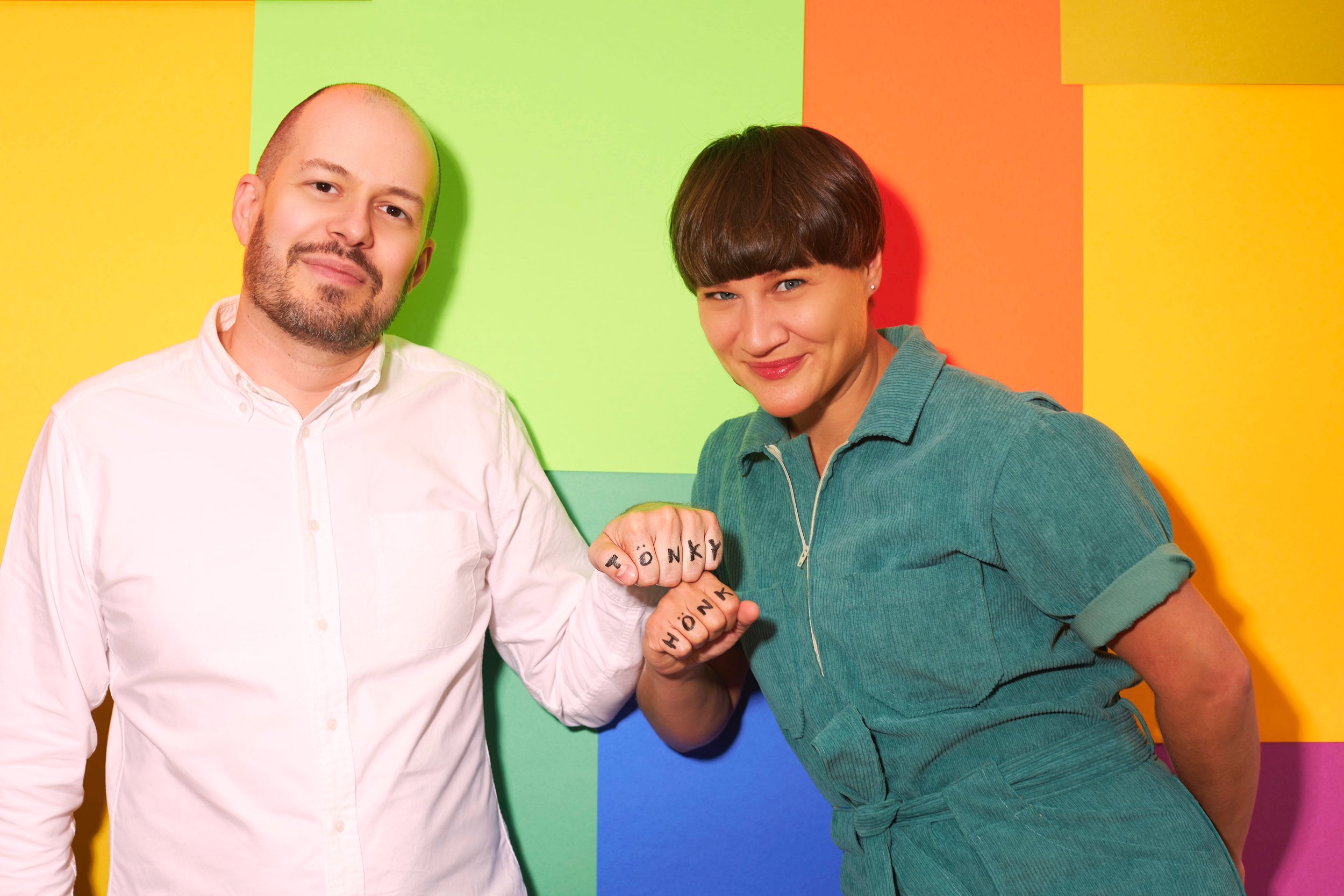
Since their inception Tönky Hönk has been cultivating their own unique vision of the piano duo—one that rushes straight to the fore on their debut recording for Redshift. Its members, Madeline Hildebrand and Everett Hopfner are each accomplished and curious players in their own right. For starters, both are past prize-winners of Canada's Eckhardt-Gramatté National Music Competition. Hildebrand currently teaches piano, chamber music, and piano pedagogy as a member of Memorial University's Music Faculty in St. John’s, Newfoundland, and has performed alongside important artists such as Philip Glass at Winnipeg New Music Festival, the Kronos Quartet at Mass MoCA, and with Yarn/Wire at the DiMenna Center in New York City among others. Her formative teachers include Gilbert Kalish, Christina Dahl, Jane Coop, and Judy Kehler Siebert. Hopfner meanwhile, was the former director of the Eckhardt-Gramatté Conservatory of Music at Brandon University and has also variously been heard strumming piano strings surrounded by whale skeletons in Frankfurt’s Senckenberg Museum, tinkling away at the jeu de timbres on tour with the Junge Deutsche Philharmonie, and performing on cathedral steps under the stars as a pianist for Casalmaggiore International Music Festival in Italy. He enjoyed the mentorship of teachers Megumi Masaki, Catherine Vickers and Nicolas Hodges.
Tönky Hönk projects an irrefutably playful image, and this surface appearance matches the wonder with which they approach keyboard instruments. The present recording—even with its relative brevity—sees them exploring an array of electric and acoustic instrumentation—Fender Rhodes, toy piano, music boxes, metal bowls, and, of course, the grand piano (which they prepare here, too). Yet, pressing play immediately reveals something that might seem to contradict their umlaut-laden spellings and dayglo artwork.