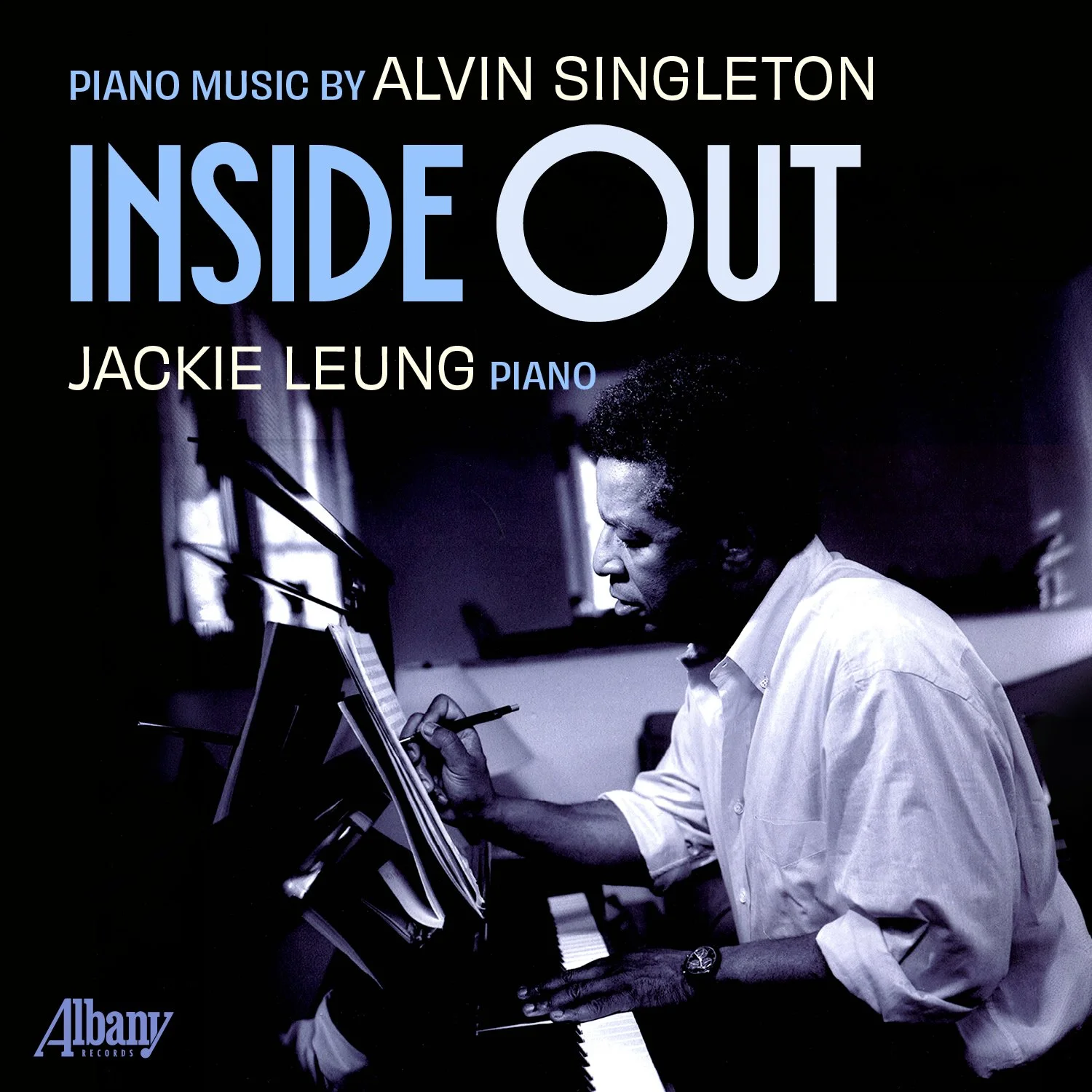
There’s a special alchemy that occurs when we discover music that we play from the inside out. We learn the notes as if we’ve written them ourselves, and as the piece comes alive in our hands, it unfolds as an inevitable extension of our musical voice.
Pianist Jackie Leung experienced this alchemy in 2020 when she was introduced to Alvin Singleton’s music, and when the composer first heard her play one of his pieces, he was struck by how “she played it like she’d written it.” It was perhaps inevitable that they’d eventually collaborate on a recording featuring all of Alvin Singleton’s published piano music. Inside Out: Piano Music by Alvin Singleton is the beautiful result of their musical syncronicity.
Alvin Singleton’s career spans six decades and his numerous works for theater, orchestra, solo instruments, and chamber ensembles have been performed by symphonies, individuals, and ensembles world wide. His multiple awards, fellowships, commissions, and residencies have given him global recognition and acclaim. As a composer, his piano music is informed by the improvisation and jazz he heard while growing up in Brooklyn. Many of his works bring attention to events that call for social justice or commemorate an event or individual. His is a commanding voice—one that asks much of both performer and listener.
Jackie Leung’s shimmering, clean and clear playing highlights the best in Alvin Singleton’s music. Her musicianship, defined vision, and masterful sense of pulse reveals the soul of even the most aurally challenging pieces. She plays with deep understanding of the structure of each piece, even when there are fewer notes than silences, always offering invitations to the listener to join her in delighting in this music.
When I was introduced to this recording, I asked if I might be able to interview both of them about this project. Remarkably, they both said yes, providing a unique glimpse into the creative alchemy between composer and performer. It is an honor to Alvin Singleton and Jackie Leung on No Dead Guys.
Alvin Singleton
I understand that when you were young you were steeped in both jazz and European classical music. When did you know that you were a composer, and how do you feel these two musical traditions shape your compositions?
Well, when I was young, I had no idea what Classical was or what Jazz was. What I heard all the time was pop music and Spirituals from my parents’ church [a United Methodist Church in Singleton’s hometown of Brooklyn]. As far as being a composer, I had no idea what that was or that music would be so important to my life. However, we had an old upright piano in the house that I used to improvise on, and the improvisation was based on what I heard on the radio or in the neighborhood. My improvisation would drive my mother and my sister crazy. Eventually, a woman at the church gave me piano lessons, and those lessons, combined with what I thought I knew and the noise that I made - according to my mother and sister -, here I am!
As an award-winning composer, most of your works were written for ensembles. What were some of the joys and challenges of composing for solo piano?
Writing music is difficult whether solo piano or ensemble. It is a joy writing for the piano since it’s the only instrument I know [how to play]. I improvised at the piano. I would play something and immediately write it down. Or I would write down what I thought I heard someone else play. I enjoyed that and I enjoy that to this day.
All the compositions on Inside Out were written for other pianists. Why did you feel Jackie Leung was the best pianist to record these pieces, and what unique qualities does she bring to your music?
I heard Jackie play a piece of mine once, and I thought it was just wonderful. She played it like she had written it. She really understood the music. I think that she is a fabulous pianist and it was her idea to do this recording. Further from my mind was refusing it. [Laughs]. She’s a wonderful pianist and a terrific person.
Given that the pieces featured on Inside Out were written throughout your long career, how do you feel your style has evolved from “Mutations”, composed in 1966 to “In My Own Skin” written in 2010?
When I look at these pieces, I find ideas that I had long ago that have developed over time, and I look at something and think, “Oh yes, I used to write this way, or that way.” It’s always developing. You go back and you find the same idea in an earlier piece.
One of the many things I enjoy about your piano music is your masterful use of silence to help create structure. What would you be willing to share about this powerful element in most of these pieces?
This idea of silence is intuitive. This is the number one question that people ask about all of my music – not just piano music, but all of my music. They say, “Your use of silence is amazing,” but I don’t realize I’m doing it, it’s so natural and intuitive – even in conversation.
I understand that “Inside-Out”, a four-hand piano work, asks both pianists to improvise. How much pitch and rhythmic material did you give them?
I gave them very little. I have each piano part structured around a scale and they use that scale (which is used in the entire piece) and I ask them to use that to make up things. To invoke things around these scales, which is reminiscent of what I did earlier in life. I would just improvise.
Where can pianists purchase sheet music copies of your music?
You can find my music at schott-music.com and psnymusic.com.
Jackie Leung
I understand that you began piano lessons at age six and by the time you were in your early twenties you knew music would be your career. When did you fall in love with modern classical music, and what composition first caught your interest?
That’s right. I began my appreciation and fascination for modern classical music towards the end of my undergraduate studies at the Schulich School of Music of McGill University. The first composition to catch my interest was a piano solo piece called “Scenes From a Jade Terrace” by Canadian composer Alexina Louie. This was a very programmatic piece centering around East Asian harmonic and melodic inspirations. It introduced me to the world of extended techniques like strumming the strings in the piano, finding and playing harmonics and more. Another composition that caught my interest in modern classical music was the “Piano Preludes” by Bulgarian-Canadian composer Alexandra Fol. Fol was a student at McGill at the same time as me and we worked together to premiere her piece. I loved the excitement of fresh music and the real-time energy of conversing with a composer who was encouraging and excited about my playing. Her piece was interesting in that a performer could perform the preludes in any given order within some parameters, and that each prelude was very short and to the point, with a clearly different characterization for each. The notation and rhythmic language was fairly traditional but the harmonic language was not really tonal which was new to me at the time. This allowed me to gain appreciation for different harmonic languages that veered outside of tonality.
When did you discover Alvin Singleton’s music and what drew you to begin learning and performing it?
I first came across Alvin Singleton’s music in 2020 during the pandemic while I was participating in a mentorship for Continuum Contemporary Music. My mentor Greg Oh, a fantastic pianist from Toronto asked all the right questions to get me thinking about myself and my life. This was a time when I had just given birth to my first child, only a few months old, and I was in search of new and meaningful experiences in performing music by composers who were outside the standard canon, especially composers of colour whose music I have not played. Alvin’s music spoke to me as he had a pianistic background and there were some previews online through the EADMC/Schott website I believe of some of his music. The titles of his music were quite intriguing, the music appeared challenging and rhythmic. This all drew me in. It was also bewildering to me but interesting that I couldn’t find recordings of some of his piano music as he is a composer with such a long career and an extensive composition list.
After finishing the mentorship, months later Continuum asked me if I was interested in performing some of Alvin’s music on a digital episode since they knew I was already interested in his music. After the first performances of his music, which included “Changing Faces”, “Cinque”, and “In My Own Skin”, Alvin had personally called the artistic director, Ryan Scott and sent him some really positive feedback for my playing. I was thrilled, encouraged and motivated to look into more of his music on my own—and this was how it all started.
Congratulations on the release of Inside Out, featuring Alvin Singleton’s piano music! What made you decide to make this recording your debut album?
That’s a great question. The answer is rather simple. Alvin is always full of great ideas—and it was his idea that I record his works. I thought it was a meaningful project for me as some of his piano music has not been recorded before, and there was no album that contained all of his piano music in one place. It was purposeful and in that way exactly what I was looking for in a debut album.
In arriving at this decision to record his published piano works, I had already been working on Alvin’s music for a few years and by this time, we had already had several conversations by phone and email as I had been sending him videos and performances of his music that I played. This included a 45 minute pedagogical video that talks about several of his piano works in the From The Artist’s Bench series for the Frances Clark Institute. It also included a video of “Mutations” that is on my youtube channel. Later Alvin had asked me to be editor for the modern typeset score of “Mutations” by Schott publisher.
After all of this, I was interested in having him write me a piece but as his plate was quite full in terms of composing already at the time, he suggested that I record all his published piano solo pieces. It felt like that was the next natural step – to learn the rest of his published piano output at the time (which means everything except the “Bed-Stuy Sonata” published in 2024) and putting it altogether onto one album and doing more research. I also felt this was a meaningful project for me because of my experience with his music, and his trust and admiration of my playing, and it had a strong purpose—as this would be the first piano album devoted to Singleton’s music. I feel one strong purpose in playing music is to bring it to the public—and a recording allows it to be permanently catalogued for anyone to discover over time. So I hope this debut album will be the first of many meaningful projects to come.
Your playing on this album is exemplary. Through your command of the architecture of these pieces, utter musical clarity, and a rock-solid sense of time, you highlight the structure in even the most avant-garde moments. How challenging was it to find form in pieces such as “Cinque”?
“Cinque” is a work that contains five concise musical essays with each its own character. What holds the form in most of “Cinque”’s pieces is the groove – there is a subtle sense of jazz inflected and syncopated rhythmic feel in all but the fourth essay of “Cinque”. All of this is held together by a groove, something only a human performer can give, so the notes on the page won’t just be notes. Instead, the precisely notated notes, rhythms and dynamics are to be enlivened by having the pulse keep things in order but encouraging the groove to have soul. In the fourth essay of “Cinque”, consistent percussive and energetic eighth notes drive the musical form and the use of natural sustain in the uppermost registers of the piano coupled with a pedalled sustain from the lower notes of the piano registers draw attention to contrast between upper and lower register timbre and sustaining properties of the piano.
One of my favorite tracks is “Greed Machine” which is scored for piano and vibraphone. Given how intimately the two instruments intertwine, what did you and vibraphonist Ryan Scott do to balance the lines between instruments?
We really had to listen and try to match each other’s sound in terms of dynamic and attack of each note. Especially in the parts that intertwine the most – we intentionally wanted to sound like it’s weaving in and out—it was particularly challenging to do this. It is a piece that showcases the timbral similarities and blend that can be achieved between these two contrasting percussion instruments.
I love “Inside Out”, the 18 minute four-hand title track. How much improvising did you and your fellow pianist Erica Murase do in this recording and how difficult was it to stay out of each other’s way when improvising?
The improvisation actually comprised about half of the duration of the recording, set in two parts that weave in and out of notated score seamlessly. This is the longest duration of improvisation demanded in any of Alvin’s piano works. The score explicitly requests for a few minutes for each improvisation with the first being shorter than the second one. The score begins with precisely notated music and when the ensemble plays together, it was particularly challenging rhythmically in this notated portion. Then when it breaks off into improvisation and comes back, you have to find a way to communicate to your partner so you can land back together in the notated sections. Both improvised sections are based on some cells of notes that are notated in the preface of the music. This piece is really cool because every performance will not sound like another because it is so improv heavy!
It wasn’t difficult to stay out of each other’s way as naturally as a duet, we are seated in front of the notes that we would mostly play, but sometimes we crossed over to the other pianist’s area and that would be okay.
Will you be giving performances of the music on this album? If so, where might we find your concert dates?
I would like to give more performances of music on this album. When I have that confirmed I will post the dates on my website (www.jackieleung.com) and/or Instagram (@jackie_leung_piano). In the meantime, you can find some archived performances and recordings online through my youtube channel (Jackieleungpiano).
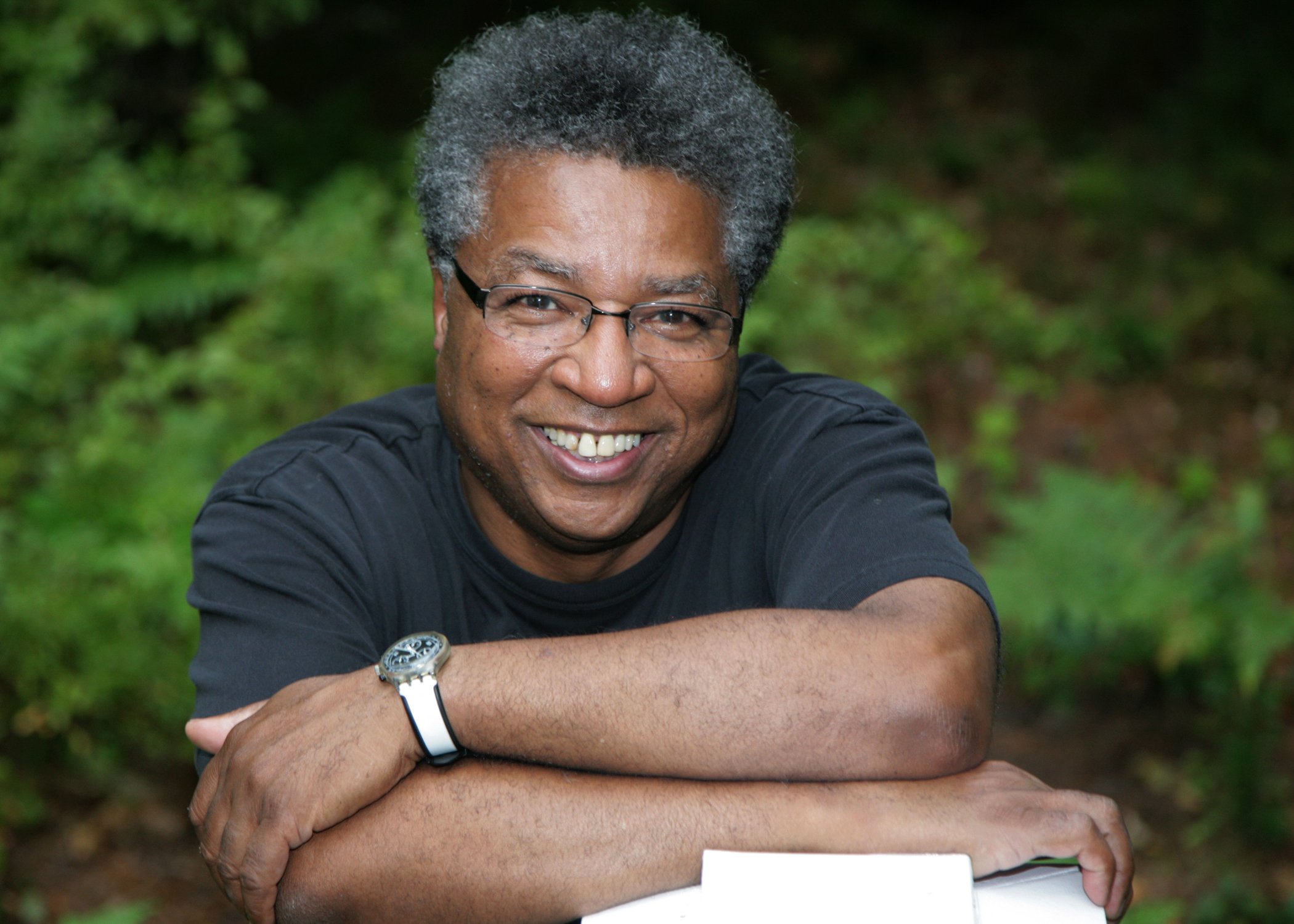
Alvin Singleton was born in Brooklyn, New York and attended New York University and Yale. As a Fulbright Scholar, he studied with Goffredo Petrassi at Accademia Nazionale di Santa Cecilia in Rome, Italy. After living and working in Europe for fourteen years, Singleton returned to the United States to become Composer-in-Residence with the Atlanta Symphony Orchestra (1985-88). He subsequently served as Resident Composer at Spelman College in Atlanta (1988-91), as UNISYS Composer-in-Residence with the Detroit Symphony Orchestra (1996-97), and was the 2002–03 Composer-in-Residence with the Ritz Chamber Players of Jacksonville, Florida. In addition, he has served as Visiting Professor of Composition at the Yale University School of Music.
Singleton has amassed numerous awards throughout his compositional life. He is the recipient of a 2003 Guggenheim Fellowship and was commissioned by The Serge Koussevitsky Music Foundation and American Composers Orchestra for the orchestral work When Given a Choice, which premiered at Carnegie Hall in April 2004. His other awards include the Kranichsteiner Musikpreis by the City of Darmstadt, Germany, twice the Musikprotokoll Kompositionpreis by the Austrian Radio, the Mayor’s Fellowship in the Arts Award by the City of Atlanta, and a grant from the National Endowment for the Arts. Also in Spring 2004, Singleton joined the American Composers Orchestra as “Music Alive” Composer-in-Residence and Artistic Advisor for the IMPROVISE! Festival. His music has been published exclusively worldwide by Schott Music since 1977, and is recorded on the Albany Records, Elektra/Nonesuch, First Edition, Tzadik, and Innova labels.
Singleton has composed music for theatre, orchestra, solo instruments, and a variety of chamber ensembles. TRUTH, a work for chorus, ensemble and dance based on the life of Sojourner Truth, was premiered in 2006 at the Ordway Center for the Performing Arts in St. Paul, Minnesota by the VocalEssence Ensemble Singers and TU Dance. Singleton’s latest CD “Sing to the Sun” was released in February 2007 on Albany Records and is the fourth all-Singleton disc. His recent work, Through It All, was commissioned by The ASCAP Foundation and Spivey Hall, and was premiered by the Grammy-nominated ensemble Imani Winds in February 2008.
In October, 2008, Singleton served as Composer-in-Residence in Tirana, Albania. He was invited by the cultural organization Eurynome Corp., who presented the Albanian premieres of selected works performed by the Orchestra of Albanian Radio and Television conducted by Oleg Arapi. Singleton also conducted a Masterclass at the Fine Arts Academy in Tirana. In November, 2008 Singleton's Brooklyn Bones, written in commemoration of the Fort Greene Park Prison Ship Martyrs Monument and setting an original text by Patricia Hampl, received its world premiere at the Brooklyn Technical High School in New York City, performed by the Monmouth Civic Chorus and Orchestra, tenor Cameron Smith, and conducted by Mark Shapiro.
His compositions have been performed by the symphony orchestras of Boston, Pittsburgh, Houston, Cincinnati, Atlanta, Cleveland, Philadelphia, Detroit, Oregon, Baltimore, Syracuse, Louisville, and Florida, the American Composers Orchestra, the Rotterdam Philharmonic, l’Orchestre de Paris, das Guerzenich-Orchester Koelner Philharmoniker and also the Kronos Quartet, the Chamber Music Society of Lincoln Center, the Nash Ensemble of London, the Asko Ensemble of Amsterdam, Ensemble des 20. Jahrhunderts of Vienna, the London Sinfonietta, Trio Basso of Cologne and the Bremer Tanztheater.
Important international festivals have also programmed Singleton’s music. They include Chamber Music Northwest in Portland, OR, Tanglewood, Aspen, Bravo! Colorado, Music from Angel Fire in New Mexico, Cincinnati May Festival, Cabrillo Music Festival, Bang On A Can, the National Black Arts Festival in Atlanta, Other Minds in San Francisco, Festival Miami, the Vienna Summer Festival, Pro Musica Nova in Bremen, the Styrian Autumn Festival in Graz, Nuova Consonanza Festival in Rome, the Brussels ISCM World music Days, and IRCAM in Paris.

Music has always been a source of fascination for the Canadian pianist Jackie Leung (Jacqueline Ching-Ling Leung). Born in Toronto, she took her first piano lessons at age 6, drawn to the family Baldwin grand piano and following the example of her older sister. She decided to make a career in music in her early twenties. It was a time when she became devoted to practicing the piano, developed a fascination with musical scholarship and wanted to perfect her technique. Today, she’s hard-pressed to imagine a life doing anything else.
Praised by the late conductor and classical radio host Kerry Stratton as a “sensitive and discerning artist,” Leung is a versatile soloist, collaborator, teacher, adjudicator, and scholar with a particular interest in championing lesser-known repertoire, improvisation, and historical performance practice. She has given masterclasses, workshops, papers, recitals, and lecture-recitals at various festivals and institutions in North and South America, Hong Kong, Europe, and the Middle East.
Adept at performing all eras of music, Leung has appeared as a soloist with orchestra in works ranging from Clara Schumann’s Piano Concerto in A minor to Olivier Messiaen’s Canyons des étoiles. She is also part of a piano trio with violinist Jin Lee Youn and cellist Yoona Jhon, who include the works of underrepresented composers in every concert program.
Teaching forms a satisfying part of her career with students that have ranged from beginners to university music majors. Leung has earned an Intermediate Award for Eurhythmics, Solfege and Improvisation from the Dalcroze International Board. Her teaching philosophy is inspired by Jacques Dalcroze, encouraging a kinesthetic experience to facilitate technical control and creative musical artistry.
She is a member of the College of Examiners for the Royal Conservatory of Music and isfrequently asked to adjudicate competitions. She’s been a keyboard lab course lecturerfor The Schulich School of Music at McGill University as well as a chamber music andundergraduate piano course instructor at Stony Brook University.
Her most memorable performances often include works that combine both notated music and improvisation. In recent years, Leung has championed the performance and study of works by distinguished American composer, Alvin Singleton. She’s been featured on Continuum Contemporary Music’s Press Play series performing several of Singleton’s works. Her pedagogical study of his piano music was also a feature for the From The Artist’s Bench series for the Frances Clark Center for Piano Pedagogy. She is also the editor for Singleton’s current edition of Mutations published by Schott.
Leung has earned a Doctorate of Musical Arts degree in piano performance from the State University of New York at Stony Brook University. She has also graduated with a Master’s and a Bachelor’s degree in Piano Performance with a minor in Management from the Schulich School of Music at McGill University. She studied with Christina Dahl, Kyoko Hashimoto, Henri-Paul Sicsic, and Thomas Davidson. jackieleung.com