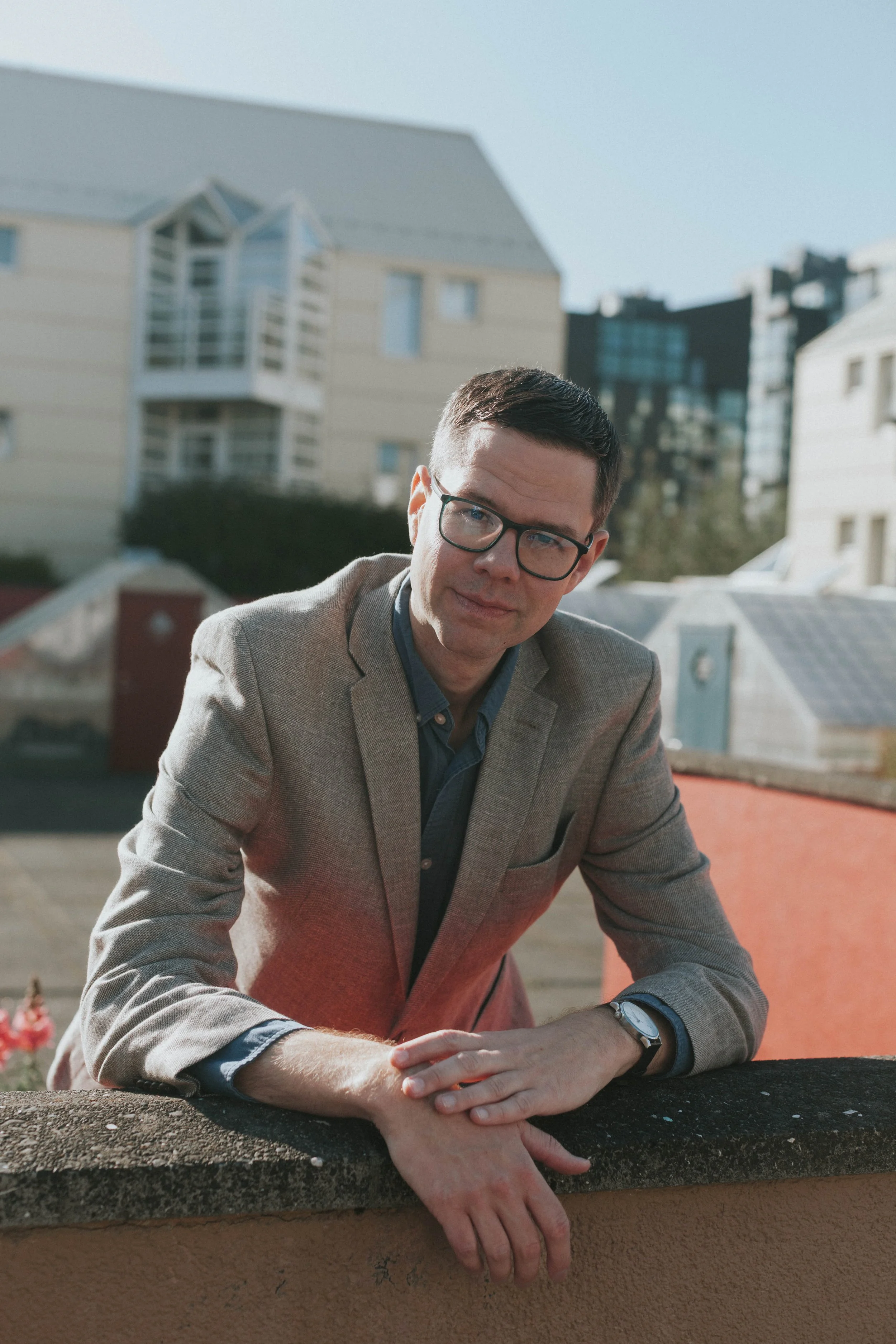
For the first decade of Ingi Bjarni’s piano training, his interest in playing the instrument waxed and waned. The discovery of jazz changed everything. In jazz his lifelong love of improvising and music creation found a natural home, and Bjarni found his career. Today, he has released 7 albums and performs his music across Iceland, Europe, and Japan. Three of his albums have been nominated for the Icelandic Music Awards and in 2020, he was awarded the most promising jazz artist in Iceland. He followed that by winning the award for Jazz Composition of the Year in 2025.
While most of Bjarni’s music features his work with other musicians, his solo piano album, Lessons—released in 2021—introduces listeners to a more intimate side of his playing. It reflects the uncertainty and change of the pandemic as well as Bjarni’s journey through personal lessons of loss and recovery. Through this album he reminds listeners how, in the hands of an artist, beauty and hope can be found in even the darkest things of life. It is an honor to feature Ingi Bjarni and his music on No Dead Guys.
At what age did you begin learning to play the piano and what drew you to the instrument?
When I was around six years old, my family was living in Sweden. My parents bought a simple electric keyboard. It did not have all the octaves, and it did not have weighted keys. I remember playing around with it. My mother studied piano when she was younger, and I remember she showed me how to play the melody of “Heart and Soul.”
I didn’t have formal music lessons until my family moved back to Iceland. That must have been when I was around eight years old. First, I took flute lessons for beginners, and then piano. I don’t think, or I don’t remember, if I ever had a real spark of interest in playing the piano at such a young age. Taking music lessons was just something my parents wanted me to do.
For the first ten years I was only practicing and playing on keyboards. It wasn’t until relatively late that my parents bought a real upright piano to have at home; I must have been eighteen years old. My interest in playing the piano was a bit on and off during those years.
I understand that you discovered jazz through the internet. Which musicians first drew you to the style and when did you decide you wanted to play jazz as well?
I discovered jazz when I was a teenager, but I had been exposed to jazz earlier in my childhood. My father sometimes showed me music by Dave Brubeck, for example, but I didn’t really connect with it. I actually don’t remember a clear turning point when I wanted to play jazz; it must have happened gradually.
And yes, with the help of the internet, I dug backwards in time, starting with techno music and then discovering funky jazz music like albums by Herbie Hancock. Later I discovered Keith Jarrett, which had a big impact on me. Discovering jazz sparked a real interest in playing the piano.
At what age did you begin writing music and what was your first composition?
The first time I remember writing something down on sheet music was when I was 14 years old. I believe it was an assignment for music theory lessons at the music school. Three years later I was playing and composing music with my instrumental rock-fusion band Hress/Fresh. It was a typical “garage band,” rehearsing in my parents’ garage – me on keyboard, a bass player, a drummer, and a guitarist. This band was very important to my development as a musician. We performed all over Reykjavík in the grassroots scene, and we even made demo recordings.
Improvisation is music creation as well. In my first memory of improvising, I was younger – probably around nine years old. I was running around the apartment with a melodica my mother owned, dancing, jumping, and improvising melodies, my playing full of emotion. I was playing simple melodies, of course, and I did not have any technique. I was improvising, though, and I really enjoyed playing music and making melodies on the spot. I enjoyed creating, uninhibited and free. This was, of course, long before I started to study jazz music, and I didn't even know what jazz or improvisation was at the time. I am very fond of this memory, and for me it's very important to remember.
When did you decide to make music your career and what influenced that choice?
I actually have a very clear memory of a turning point. When I was 20 years old, I wasn’t sure what I wanted to focus on in life. I had been playing and creating music, but I also had friends who were studying engineering, mathematics, and so on. As a result, I began studying mathematics at the University of Iceland.
But then, on a rainy November morning that first semester, I was parked in front of the university. A lecture about mathematical analysis was about to start. There I sat and thought, “What am I doing with my life? I am not a mathematician; I am a musician!” I just drove home and started playing the piano. I am happy it only took me three months – and not a lifetime – to fully realize that I wanted to be a musician.
What artists have had the most influence on you as a pianist and a composer?
Without doubt, Keith Jarrett – mainly as a pianist, but I enjoy Keith’s compositions as well, especially the European Quartet albums like Belonging and Nude Ants.
Later, as a master exchange student in Norway, I was fortunate to have lessons with Ukrainian pianist/composer Misha Alperin. His approach to teaching and to music was quite unconventional. His lessons were more philosophical than practical. At the time, this was exactly what I needed, having had many “jazz piano” teachers over the years. Misha completely changed how I approach and think about music. Even though I only had a few lessons with him, he had a huge influence on me.
As a composer, I believe that I am very influenced by lots of different music styles. I am definitely influenced by the techno/trance music I listened to as a teenager. I have also always been intrigued by some (not all) reggae and folk music from all over the world. Singer-songwriter Nick Drake is also an influence I would like to mention.
In general, what I like in music is the space in between. Is it improvised or pre-composed? Is it in major or minor? Is it in time or not? Also, if a certain melody or groove makes me feel something, touches my soul, or haunts me even, I know it’s something I like.
In a country with just under 400,000 residents I assume the jazz scene in Iceland is a tightly-knit group. In what ways has it nurtured your career?
Despite the small population, Iceland is in many ways a good place to live as a musician. As a young music student in Reykjavík, I was nurtured by studying with teachers from the jazz scene and seeing them perform at concerts.
That said, the jazz scene in Iceland is indeed very small, and honestly it can feel a bit limited. Therefore, I have always kept my eyes open for concert opportunities for my projects abroad. In that way, the jazz scene here has nurtured me indirectly.
Every August there is the Reykjavík Jazz Festival, which invites both Icelandic and international artists to play. I have been lucky to perform numerous times at that festival. I have also contributed to the local jazz scene as the coorganizer of a small concert series called “Jazz í Djúpinu,” with around 24 concerts per year.
If you want to learn more about the jazz scene, I cowrote this article for All About Jazz.
Congratulations on the numerous awards you’ve received for your music and for releasing 7 albums of your own compositions. Of all your records, which are you most proud of and why?
This is a tricky question to answer. All my albums tell different stories from different periods of my life. But if I had to choose one, I would probably say my first album, Skarkali, which I released in 2015. A lot has certainly happened to me over the past ten years, both in music and in life. And I can't say that the music on Skarkali reflects who I am today. But still, a debut album is a memorable achievement.
Given that you work primarily with other musicians, what prompted you to release Lessons, a solo piano album, in 2021?
I had been thinking about making a solo album as early as 2019, but I didn’t have a clear idea or direction. Then 2020 arrived – and we all know what happened: the pandemic. 2020 was also a very difficult year for me personally, and I learned some hard lessons about relationships (hence the album title, Lessons). So, in late 2020 I decided that I would make a solo piano album. It also felt like the natural choice during the pandemic, since playing with others wasn’t always an option.
One of the many things I enjoyed about Lessons is how the pieces form a narrative journey that ends beautifully with “Best Wishes.” Was this your initial plan or just my understanding of this album?
It was planned. I thought it would be fitting to end the album with this piece. However, when I composed it, I didn’t intentionally think it would be the final track, and the idea for recording and releasing the album wasn’t fully formed.
My favorite piece on Lessons is “Haveneringen” because of its minimalistic searching, elegant use of muted strings, and its open-ended ending. What can you tell me about the inspiration for this piece?
This piece was actually written in 2017 when I was living in Copenhagen for a few months. Biking is a very popular mode of transportation in the city. Havneringen is a bicycle route I used to cycle almost every day. I don’t know if I was directly inspired by that route when composing the piece, but it was definitely part of my everyday life at the time. And shouldn’t we sometimes dedicate our art to the ordinary things in life?
One thing I enjoyed throughout the entire album is how the loose structure of your improv sections gives each piece a sense of exploration and questioning. How much of this music was improvised in recording and how much was written down?
The music on Lessons is more through-composed than the music on my other albums – especially in the melodies and arrangements. For the majority of the pieces, both the right hand and left hand are written out. But as with all my albums, I leave space for improvised sections within almost every piece. These can be improvised intros, outros, or most often a dedicated improvisation section in the middle of the piece.
Generally, I’m happy if I can disguise my improvisations so they sound as if they were through-composed. In a way, that is my approach to improvising. I want my improvisations to be like that.
I read that you offer sheet music for Lessons. Where might we purchase it?
Yes, the sheet music for Lessons has been a bit hidden for a while (my bad). Initially it was available for purchase on my Bandcamp page, but I have decided to make it freely available as a PDF download that you can find here.
What current and future plans are you most excited about?
I am working on a personal project based on a text by my late mother about a bird’s flight. The text is a metaphor for a life of struggle and resilience. I have plans to record this with Norwegian trumpet player Jakob Eri Myhre. Hopefully listeners will connect with both the music and the story it tells.
I am also working on promoting my latest release (Hope, 2025) which features Anders Jormin on bass, Hilmar Jensson on guitar and Magnús Trygvason Eliassen on drums. The album has received great press internationally. I aim to perform with the quartet in September 2026 in Iceland and possibly elsewhere.
What advice do you offer your own piano students about creating a career for themselves in music?
I once heard: “Respect and embrace tradition, but don’t be enslaved by it.” In essence, this has been my approach as an artist. We must do our own thing — we can’t be constantly imitating others. So don’t always listen to your teachers (or others). Be independent, and be an innovator.
There are two sides to being a musician. One is the artistry: composing and practicing the craft of playing an instrument. The other is the business side, which I find extremely boring! Nobody is going to teach you all this boring business stuff; you have to learn it yourself and find what works best for your music. And be consistent with it. Consistency is key. Sometimes I am not consistent enough.
Ingi Bjarni Skúlason is an Icelandic pianist and composer who shapes his own poetics. He has released 7 albums with his music and toured both in Europe and Japan. He makes his own kind of folk music with the freedom of expressiveness, and space for both lyrical and free improvisation.
Over the years, Ingi Bjarni has performed his original music with a wide range of musicians across Iceland and Europe. He has appeared at numerous international jazz festivals, including Jazzahead (Bremen), Transilvania Jazz Festival, Elbjazz (Hamburg), Copenhagen Jazz Festival, Vilnius Jazz Festival, Lillehammer Jazz Festival, Nordic Jazz Comets, and Reykjavík Jazz Festival. In addition to these, he has given concerts in Iceland, Japan, Sweden, Germany, the UK, Estonia, Latvia, the Faroe Islands, Belgium, and the Netherlands.
Three of his albums have been nominated for the Icelandic Music Awards. In 2020, he was awarded as the most promising jazz artist in Iceland, and in 2025, he received the award for Jazz Composition of the Year. His work has received recognition and praise internationally and has been positively reviewed in a variety of magazines, blogs and other media.
Ingi Bjarni completed a Bachelor’s degree in Jazz Performance at the Royal Conservatory in The Hague (Koninklijk Conservatorium) in 2016. In the spring of 2018, he finished a specialized Master’s program in composition, Nordic Master: The Composing Musician, with semesters in Gothenburg, Copenhagen, and Oslo. The program emphasized artistic values and compositional craft, complementing his earlier focus on classical jazz piano performance. His teachers and mentors have included Misha Alperin, Anders Jormin, Helge Lien, Aaron Parks, Eyolf Dale, Eric Gieben, Agnar Már Magnússon, and Helge Sunde. In spring 2024, he completed a diploma in arts education at the Iceland University of the Arts.
In addition to his work as a performer and composer, Ingi Bjarni is active as a music educator, teaching piano and accompanying students, as well as giving talks on flow and musical creativity – most notably at the Iceland University of the Arts and the Academy of Music and Drama in Gothenburg. He has also created and hosted In Duo With, a concert series and YouTube program where he invited Icelandic musicians for conversations about improvisation and music-making, followed by duo performances.